
Document Conversion Services
Structured Automation from Old-School Documents
FSI provides accurate transformation of emails, PDFs, spreadsheets, and faxed documents into structured electronic transactions to remove manual processes.
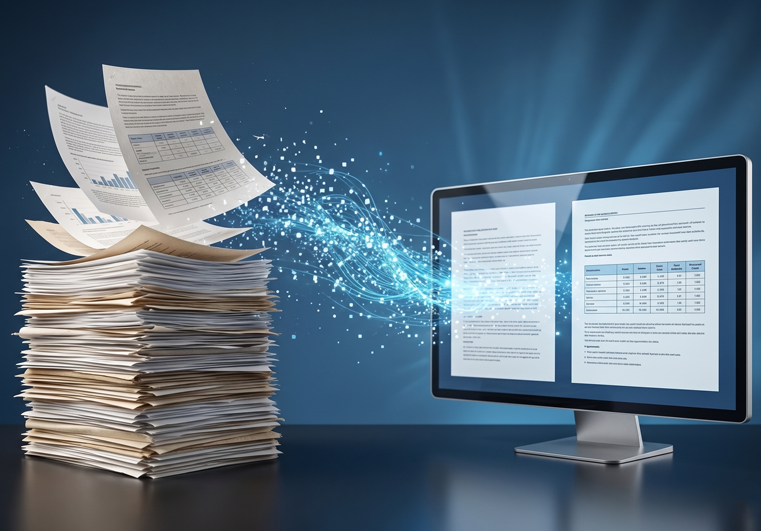
What Are Document Conversion Services?
Document Conversion Services convert non-EDI documents into structured digital data messages, using the latest in AI and machine learning.
When your trading partners send orders, transportation documents, status or invoices via email or fax, FSI will interpret them using applied validation rules.
The PDF, JPG, or even email body text are transformed into standardized EDI data or other required formats and delivered directly to your management software or via VAN, SFTP, AS2, or Web API.
An audit portal provides your staff with access to original documents and transaction history.

Why Companies Use Document Conversion Services?
Companies rely on document conversion when manual data entry becomes costly and unsustainable.
What unsustainable looks like:
- Employees re-key purchase orders and invoices
- Processing delays impact fulfillment and billing
- Manual errors create compliance risk
- Document formats vary by trading partner
- Paper-based workflows disrupt EDI automation
- Keeping in-house staff current on AI and other conversion models
Document Conversion Services can operate independently or alongside Managed EDI and VAN services.
Savings Calculator
Document Conversion Services can operate as a standalone solution or integrate seamlessly with Managed EDI and VAN services to support end-to-end data flow.
It can cost up to $30 to process a single invoice manually. Document Conversion Services may be able to help you cut costs.
What Implementation Looks Like with FSI
FSI provides document conversion services using data capture and workflow with configurable validation and routing options.

Automation accuracy rates can reach up to 99.95%.
Define document types and required data elements
Extract and map structured data fields
Apply business rules and database validation
Deliver via VAN, WebAPI, SFTP, or AS2 connectivity
Provide audit visibility and exception management
Frequently Asked Questions (FAQ)
What is EDI document conversion?
EDI document conversion transforms PDFs, emails, and other non-EDI files into structured electronic transactions.
What types of files can be converted to EDI?
Common formats include PDFs, emails, spreadsheets, scanned images, and faxes.
Who should use EDI document conversion?
EDI document conversion is ideal for companies that receive orders, invoices, or tenders via email, PDF, or fax and want to automate those transactions without requiring partners to adopt full EDI.
What’s the difference between document conversion and EDI integration?
Document conversion translates incoming documents into structured formats without requiring full EDI setup from partners. Traditional EDI integration requires direct system-to-system connections and onboarding.
How are document conversion services different from Web EDI?
Document conversion uses AI, machine learning and optical recognition to automate the processing of incoming documents to create standardized data messaging, while Web EDI provides a portal where partners manually enter or submit transactions through a browser.
Is document conversion the same as data capture?
No. Data capture extracts information, while document conversion validates, maps, and transforms that data into structured formats ready for automation.
Can document conversion help automate non-EDI partners?
Yes. Document conversion allows companies to automate transactions from suppliers or carriers who are not EDI-enabled, reducing manual entry without forcing partners to change how they work.
What do my trading partners have to do differently if I use Document Conversion Services from FSI?
There’s almost no change to their processes, aside from possibly providing them with a new fax number or email address to send these documents. If you are currently using an email group for these types of communications, you can add the new email address to that group, and your trading partner won’t need to take any action
How does using document conversion affect service to my trading partners?
How long does it take to implement document conversion?
Implementation timelines vary, but many document conversion services can be deployed faster than full EDI integrations because trading partners don’t need new systems or onboarding.
How does document automation reduce processing costs?
Can document conversion integrate with existing EDI services?
Yes. Converted transactions can be delivered through existing VAN, SFTP, or AS2 environments.
How Do I Get Started?
Document intake requirements vary by volume, format, and workflow complexity.